
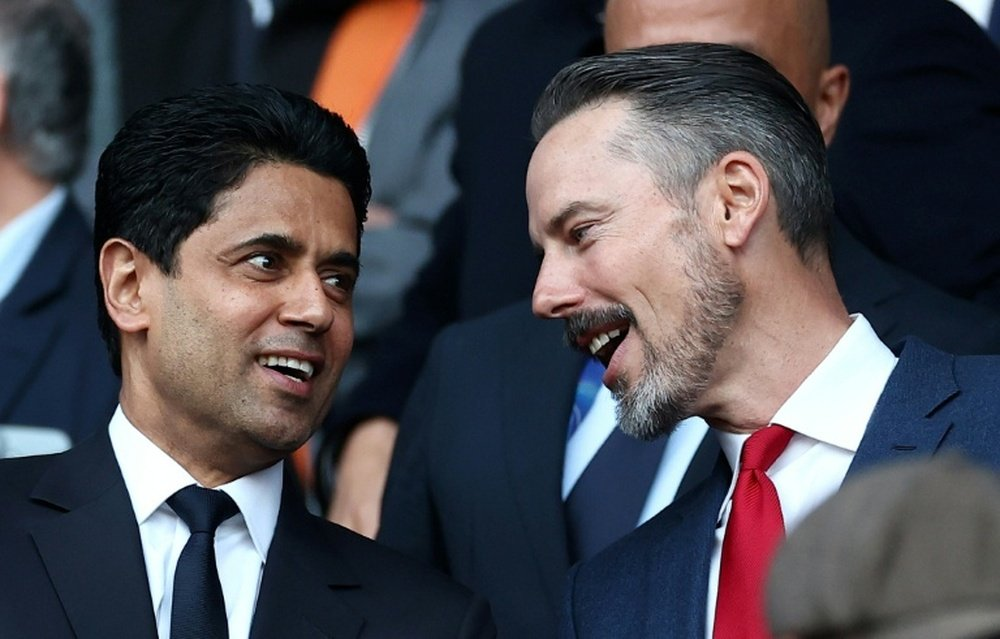
While their tactical approaches may differ, the divide between Paris Saint-Germain and Arsenal runs deeper, from divergent financial models to contrasting infrastructure, despite a shared commitment to youth.
Ownership: State power vs private enterprise
Since 2011, Paris Saint-Germain has been under Qatari ownership via the Qatar Sports Investments (QSI) fund, fronted by president Nasser Al-Khelaïfi. To date, the Gulf state has officially injected 1.4 billion euros into the Parisian project through the QSI vehicle.
The club’s valuation has skyrocketed from 70 million euros in 2011 to 4.2 billion in December 2023, a figure cemented by the sale of a minority stake to the American investment firm Arctos. QSI’s footballing portfolio also extends to Belgium, where they own KAS Eupen.
In contrast, Arsenal have been under the stewardship of American billionaire Stan Kroenke (78) since April 2011. The real estate mogul assumed full control of the North London club in 2018 and now co-chairs the board alongside his son, Josh Kroenke.
A low-profile septuagenarian with a penchant for long-term projects over immediate gratification, Kroenke has built a formidable empire under the Kroenke Sports & Entertainment banner. His stable includes the Denver Nuggets (NBA), Los Angeles Rams (NFL), Colorado Avalanche (NHL), and the Colorado Rapids (MLS).
Capital and budget
Operating with a budget of approximately 600 million euros, the Gunners flexed their financial muscle last summer. The club secured high-profile signings including Viktor Gyokeres, Eberechi Eze, Martin Zubimendi, Noni Madueke, and Cristhian Mosquera, alongside deals for Kepa, Hincapie, and Norgaard.
In Paris, the financial scale is even loftier, with a budget estimated at 880 million euros, firmly establishing PSG among the global elite.
However, their priorities diverge regarding the women’s game. While PSG have scaled back its investment, Arsenal have elevated its women’s team to a priority status. The Gunners are currently a dominant force in Europe, having secured the Women’s Champions League last year and reaching the semi-finals this term.
Sporting direction
In 2025, Arsenal entrusted their sporting direction to Andrea Berta, the man who spent twelve years as Diego Simeone’s influential operator at Atletico Madrid. The 54-year-old Italian arrived with a formidable reputation in the transfer market.
The former banker was instrumental in the pursuit of Gyokeres over Slovenian talent Benjamin Sesko and convinced Mikel Arteta to move for 21-year-old defender Cristhian Mosquera from Valencia—a signing now regarded as one of the summer’s most astute pieces of business.
In Paris, the 61-year-old sporting advisor Luis Campos remains the architect of the first-team squad. The Portuguese specialist, whose CV includes stints at Real Madrid, Monaco, and Lille, recently saw his contract extended until 2030, granting him even greater autonomy.
Campos manages the Parisian transfer strategy in close tandem with head coach Luis Enrique and “NAK”. He is credited with unearthing several recent gems, most notably Joao Neves and Willian Pacho.
Stadium infrastructure
PSG remain tenants rather than owners of the Parc des Princes, a situation that has become increasingly restrictive as the club’s global brand has expanded. Despite a desire to purchase and renovate their historic home, the club met a firm rebuff from the Paris City Hall in late 2022. This led to a fractured relationship with Mayor Anne Hidalgo, prompting the Parisian hierarchy to explore the construction of a new flagship stadium in Massy or Poissy.
However, the election of Emmanuel Grégoire in March has seen a thaw in relations. Could this diplomatic shift bring the purchase of the Parc des Princes back to the negotiating table?
Despite the ownership deadlock, the stadium remains a goldmine, generating record matchday revenue through consistent sell-outs and lucrative VIP hospitality packages.
Unlike their French counterparts, Arsenal own the Emirates Stadium. The ultra-modern 60,000-seater arena was inaugurated in 2006, just a stone’s throw from their former Highbury home (which housed 38,400 at its closure).
The benefits of ownership are clear: matchday revenue, including ticketing and merchandising, reached nearly 177 million euros in 2025.
The youth conveyor belt
In Paris, the youth academy has been repositioned as a cornerstone of the club’s identity. This shift was solidified by the 2023 opening of the state-of-the-art PSG Campus, where academy prospects, the women’s team, and the men’s senior squad all train within the same elite environment.
The rise of Warren Zaire-Emery and Senny Mayulu has provided the project with its poster boys. Luis Enrique has shown a willingness to blood several other youngsters this season, though the club still faces the perennial challenge of retaining their brightest “titis” against interest from across Europe.
Similarly, Arsenal continue to reap the rewards of its famed Hale End academy in North East London. Star winger Bukayo Saka, who joined the club at the age of eight, is the ultimate symbol of this homegrown success. The current first-team squad also features fellow graduates such as Myles Lewis-Skelly (19) and the prodigious 16-year-old forward Max Dowman.